UL 325 explained: what makes an automatic gate safe
What the UL 325 standard requires of automatic gate openers: entrapment protection, monitored sensors, gate classes, pedestrian access and warning signs. Plus the ASTM F2200 gate rules.
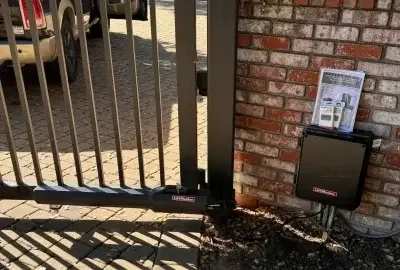
What UL 325 covers
UL 325 is the standard gate openers are tested and listed to. It focuses on entrapment: the risk of a person being caught by a moving gate. The opener has to sense an obstruction and stop or reverse, and the installation has to protect the places where a gate can trap someone, like the gap at the end of a slide gate or the space behind a swing gate as it opens.
Entrapment protection
- Built-in sensing: the opener itself reverses when it feels unusual resistance.
- Photo eyes: infrared beams across the gate path that stop or reverse the gate when something crosses them.
- Safety edges: soft, pressure-sensitive strips on the leading edge of the gate that reverse it on contact.
Openers listed under recent editions of UL 325 monitor these external devices. If a photo eye or edge is missing, unplugged or faulty, the gate won’t run automatically until it’s fixed. That’s why a gate sometimes refuses to close after a sensor is bumped.
Gate classes
- Class I: homes and small residential setups.
- Class II: commercial or public places, like apartment buildings, HOAs and hotels.
- Class III: industrial sites not meant for the general public.
- Class IV: restricted sites with guards or limited access.
The class decides which operator and how much protection a site needs. An HOA entry is held to a higher standard than a single-family driveway.
The gate itself: ASTM F2200
A safe opener on an unsafe gate isn’t enough. ASTM F2200 covers how automatic gates are built. Slide gates should have their openings screened from the ground up to about 6 feet, so a hand or arm can’t reach through near moving parts. Rollers and wheels should be covered, and gaps between the gate and posts kept tight. Older ornamental gates often need mesh added before they’re automated.
People need their own gate
UL 325 expects pedestrians to use a separate walk gate, not the moving vehicle gate. Warning signs should be posted on both sides of the gate, and remotes and controls should be kept out of children’s reach.
Is your gate up to date?
Gates installed years ago often have no photo eyes, unmonitored sensors or open bars near the motor. A gate safety inspection checks the opener, sensors, edges, gate construction and signs, then lists what’s needed. Every gate we install follows UL 325.
Questions
Is UL 325 required in California?
UL 325 is the standard gate openers must be listed to, and California also has its own rules on automatic gate safety. Any new opener we install is UL 325 listed and installed with the required protection.
Why won’t my new gate close without the photo eyes?
Openers built to current UL 325 monitor their safety devices. If one is missing or faulty, the gate won’t close automatically until it’s fixed.
Do I need a separate walk gate?
Yes, pedestrians should have their own gate so they never walk through the moving vehicle gate.
Can an old gate be made compliant?
Usually. Adding monitored photo eyes and edges, screening open bars and guarding rollers often brings an older gate up to standard without replacing it.
Eagle Automatic Gate & Door repairs and installs gates and garage doors across the Bay Area. Call or send a request.